Sole author — research preprint · Cited in PeerJ CS (Q2), Apr 2026
A neural network that predicts near-optimal PID gains from a robot's physical parameters (mass, damping, inertia) in under 0.2 ms, replacing hours of manual tuning.
What I did
Built the physics simulation and generated the dataset: 1,000 robot configurations, each optimized with the Nelder-Mead method.
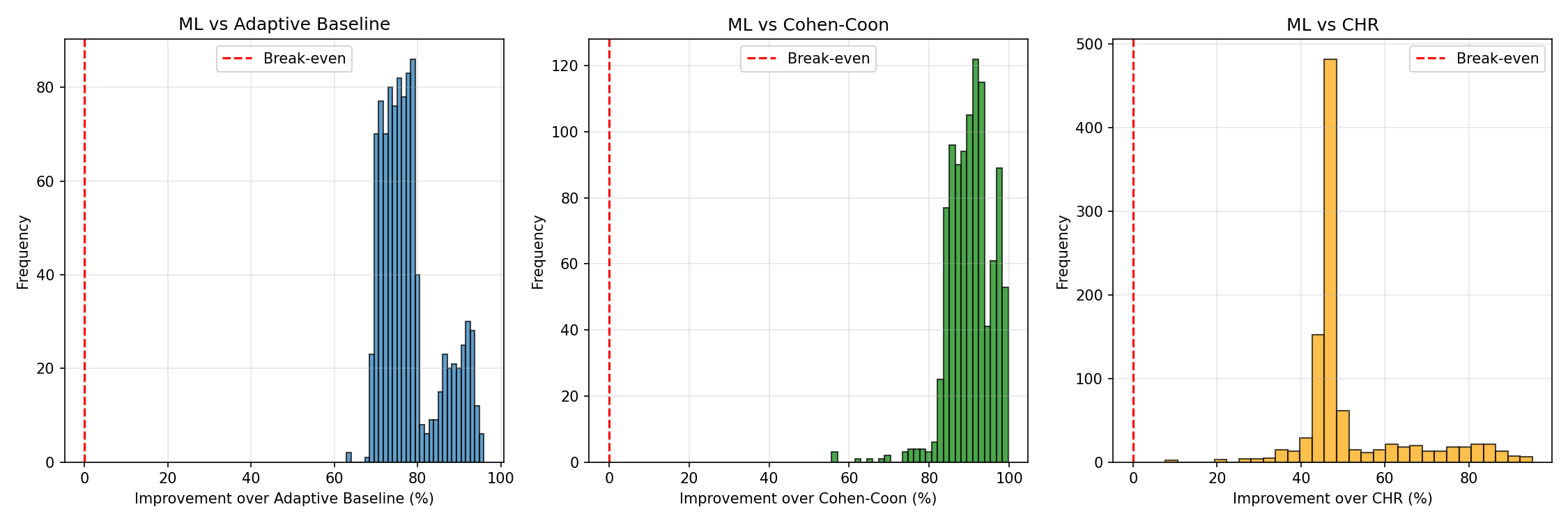
Trained an MLP (3→128→64→32→3) that maps physical parameters to PID gains; 78–90% average improvement over Cohen-Coon, CHR and an adaptive baseline, 100% success rate on 1,000 held-out cases (p < 1e-10).
Tested noise robustness up to 20% and published everything — code, data and figures — openly.
Published as a TechRxiv preprint; cited in a PeerJ Computer Science article in April 2026.
Improvement distribution vs classical tuning methods. Figure from the public repository.